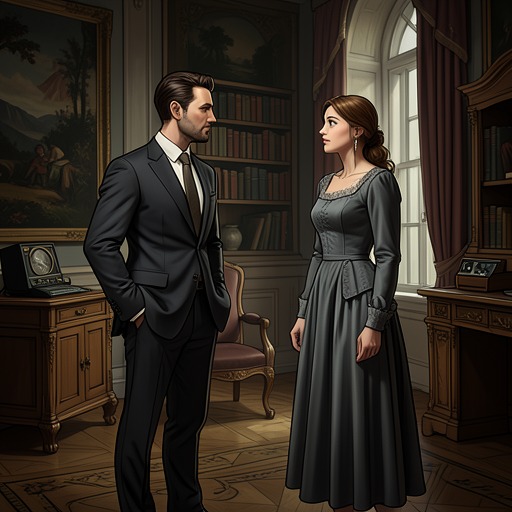
Ralph Denham’s pursuit of Katharine Hilbery
Night and DayRalph Denham’s pursuit of Katharine Hilbery is as much a movement of imagination as a sequence of approaches. After leaving the Hilbery house, he resolves to make Katharine his chosen object of attention; later, he turns that resolve into awkward attempts to hold her interest and a deliberate decision to follow her from Mary Datchet’s office. The pursuit is powered by fantasy, but repeatedly unsettled by contact with Katharine as a person beyond his imagined design.
The decision to make Katharine his focus
Walking away from the house, Ralph’s thoughts initially return to the people he has just left. As he moves through London, however, the remembered scene slips from literal recollection into invention. He says aloud, "She'll do. . . . Yes, Katharine Hilbery'll do. . . . I'll take Katharine Hilbery." The language turns attraction into a choice: he imagines selecting Katharine to fill an absence in his mind.
Once he has made that choice, his earlier critical resistance gives way. He dwells on the charm and beauty he had tried to disown, and on the character and aloofness he had been determined not to feel. When memory runs out, imagination takes over. He enlarges her height, darkens her hair, and, more consequentially, reshapes her mind into something exalted and nearly infallible. In his fantasy she is independent and lofty, yet ultimately makes an exception for Ralph and crowns him with her approval. His attraction therefore begins in a double movement: he admires Katharine’s imagined independence while scripting that independence to end in recognition of himself.
This inward portrait has a practical purpose for him. Katharine, he decides, will do for weeks, perhaps months; imagining her supplies something that had left a bare place in his mind. The narration makes the gap between desire and knowledge central from the outset: Ralph knows he is constructing a vision, but his awareness does not prevent him from feeding it.
Pursuit through awkward encounters
At a gathering where Mary Datchet and Katharine are present, Ralph waits for an opening and produces a prepared question about whether Katharine remembered to have a picture glazed. Its triviality and strained delivery make his effort conspicuous to Mary, who silently judges the remark foolish. Katharine recalls the picture and the Sunday afternoon associated with it, but the brief exchange leaves the three standing in an awkward silence. Ralph has managed to speak to her, not to establish ease.
His unspoken determination is more forceful than his conversation. He wants Katharine to stay until he can somehow conquer her interest; she, sensing that he has fixed his attention on her, recalls their first meeting and assumes he judges her severely. She responds by standing still and nearly closing her lips, though the desire to laugh stirs them. Ralph then asks whether she knows the names of the stars, in a tone that seems to resent the knowledge he attributes to her. The scene shows pursuit as a contest between his concentrated intention and her guarded, amused reserve, not as mutual understanding.
The imagined Katharine and the actual one
After meeting Katharine at the Hilberys’, Ralph repeatedly sustains an imagined version of her in private. As he walks home from the office, this phantom Katharine answers him as he wishes and is present to crown his imaginary victories. His decision to follow the real Katharine arises partly from a fear that, if he lets the chance go, he will be left alone to face the accusing figure his own indecision produces. He reasons that an uncomfortable real conversation is preferable to another evening of excuses and impossible scenes.
Yet he understands that the imagined figure leaves out much of Katharine herself. An actual walk together might give the phantom fresh material, or refine it until it becomes too insubstantial to serve him; either result differs from simply meeting a woman he already knows. Katharine, for her part, wants solitude for her own imaginative activity and finds the office she has visited dreamlike and strange. Their respective inward worlds run alongside the encounter without coinciding: Ralph’s fantasy draws him towards her, while her own reverie makes his company an interruption.
Following her from Mary’s office
On a later afternoon, Katharine walks up Kingsway in search of a place to take tea and talk. The traffic and approaching evening have put her in a heightened, unsettled mood, poorly suited to going home. Remembering Mary’s repeated invitations, she crosses into Russell Square and searches for Mary’s workplace. After first being directed to the wrong organization, she climbs past glass doors marked with initials to the office, where she arrives during a rush of work caused by missing printer’s proofs.
The bright, unshaded electric light and paper-covered table strike Katharine as intensely concentrated after her twilight walk. She looks towards the uncurtained window, but Mary draws her back into the room. To Mary, Katharine’s long cloak and composed, apprehensive expression seem out of place in the working office; the contrast briefly makes Mary anxious that her own world will not appear important to her visitor. These differences in how the two women inhabit the scene help explain why Katharine’s presence unsettles Mary as well as Ralph.
At tea, Mary speaks about honesty and the harm caused by lies. Katharine answers that everybody tells lies, then laughs while looking over the presses and cupboards. Mary reads her amusement as potentially mocking and watches her fiercely. Ralph, meanwhile, decides that if Katharine leaves, he will go with her. When Katharine says goodbye, he rises, nods to Mary, opens the door, and follows her into the street. The action is quick, but the narration traces its reasoning: he would rather risk present discomfiture than return to the private cycle of imagined conversations and self-reproach.
The pursuit’s unresolved tension
Katharine is surprised and perhaps annoyed when Ralph keeps pace beside her. She would rather walk quickly down Tottenham Court Road, take a cab, and return home alone. For her, the office and its workers have acquired the unreality of a dream; for Ralph, the walk offers a chance to feed or correct his own dream of her. Their meeting thus carries two contrary pressures: his wish for proximity and her wish to preserve the solitude in which her thoughts can move freely.
The wider course of the relationship gives the pursuit a painful counterpoint. When Ralph later asks Mary to preserve their friendship after his proposal, Mary thinks with anguish that she could have given him everything. Her response makes plain the unequal distribution of longing among the three: Ralph’s attention is directed towards Katharine, while Mary’s love for him remains unreturned. The pursuit is therefore not only a private romance of imagined triumphs; it also shapes the emotional costs borne by someone whom Ralph asks to remain close as a friend.
Nor does the pursuit become a simple story of imagination yielding to possession. Katharine’s later movement through Lincoln’s Inn Fields, where she buys a large-scale map of Norfolk while trying to find Ralph at his office, reverses the direction of seeking. She waits among the professional buildings and then becomes absorbed by the traffic flowing along Kingsway, its impersonal current briefly seeming to express life’s ordinary purpose. The scene places her own imaginative and emotional movement beside Ralph’s earlier approach: desire can draw a person towards another, but neither city space nor fantasy guarantees an encounter or control over its outcome. Across these episodes, Ralph’s pursuit remains defined by the tension between approaching Katharine and having first invented the version of her he hopes will answer him.